
As of July 2026, cryptocurrency is legal in Pakistan under the Virtual Assets Act, 2026. Crypto-related businesses must comply with the new regulatory framework established by the Pakistan Virtual Assets Regulatory Authority (PVARA). Virtual Asset Service Providers (VASPs), including exchanges and wallet providers, are required to obtain licensing and follow AML/CFT regulations.
Is Crypto Legal in Pakistan 2026?
Yes.
After years of uncertainty, Pakistan crypto regulation 2026 has introduced a formal legal framework through the Virtual Assets Act, 2026. Instead of banning cryptocurrencies, Pakistan now regulates them under a dedicated authority known as PVARA (Pakistan Virtual Assets Regulatory Authority).
For investors, this means:
- Crypto ownership is recognized under the regulatory framework.
- Licensed service providers can legally operate.
- AML and KYC compliance are mandatory.
- Consumer protection has significantly improved.
What Changed in Pakistan Crypto Regulation 2026?
The biggest milestone was the implementation of the Virtual Assets Act, 2026, Pakistan’s first dedicated crypto law.
Major changes include:
| Before 2026 | After 2026 |
| Regulatory uncertainty | Legal framework established |
| No dedicated regulator | PVARA regulates crypto |
| Limited banking support | Licensed firms can access banking services |
| No licensing system | Mandatory licensing for VASPs |
The framework aligns Pakistan with international FATF standards while encouraging responsible blockchain innovation.
Is Bitcoin Legal in Pakistan?
Yes.
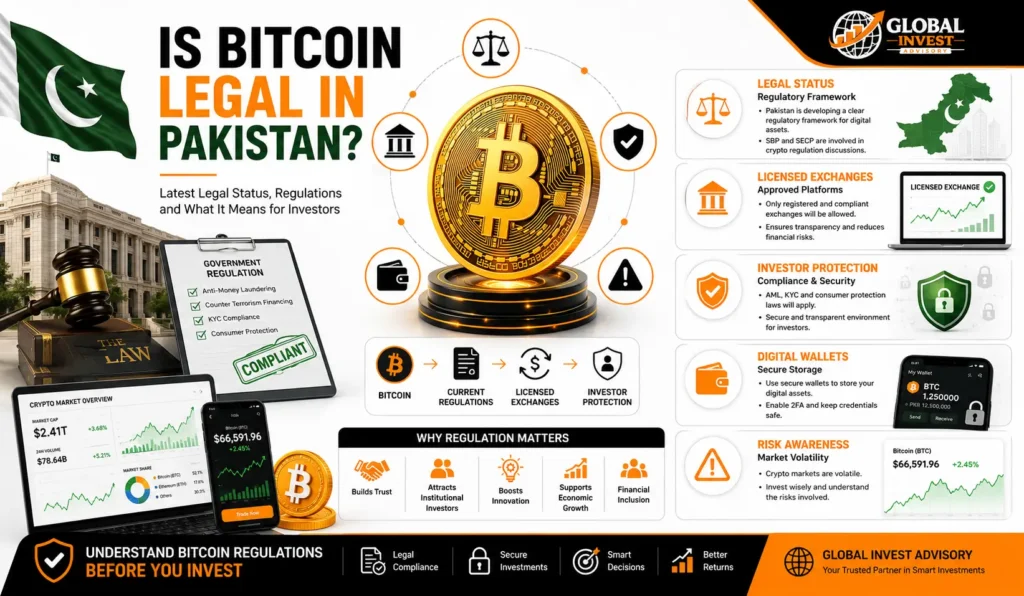
If you’re wondering “Is Bitcoin legal in Pakistan?” The answer is yes, provided activities take place within Pakistan’s regulated framework.
Bitcoin is treated as a virtual asset under the new law. However:
- Investors should use regulated platforms.
- Exchanges must obtain PVARA approval.
- Transactions must comply with AML regulations.
- Investors remain responsible for understanding market risks.
Bitcoin remains highly volatile despite its legal recognition.
What is PVARA Pakistan Crypto?
PVARA (Pakistan Virtual Assets Regulatory Authority) is Pakistan’s dedicated crypto regulator established under the Virtual Assets Act 2026.
Its responsibilities include:
- Licensing crypto exchanges
- Supervising Virtual Asset Service Providers
- Preventing money laundering
- Protecting investors
- Enforcing compliance standards
- Developing crypto regulations.
PVARA has also launched consultation drafts for Virtual Asset Service Regulations, indicating Pakistan’s commitment to a structured licensing framework.
What is the Role of SECP Crypto Regulation Pakistan?
Many investors confuse SECP with PVARA.
Here’s the difference:
| SECP | PVARA |
| Regulates securities and companies | Regulates virtual assets |
| Oversees capital markets | Licenses crypto businesses |
| Corporate governance | Crypto compliance |
While SECP continues regulating traditional financial markets, PVARA specifically oversees crypto assets and Virtual Asset Service Providers.
Understanding the Virtual Assets Act Pakistan
The Virtual Assets Act, 2026 provides Pakistan’s first comprehensive crypto legislation.
Key highlights include:
Mandatory Licensing
Crypto exchanges, custodians, wallet providers, brokers, and token issuers must obtain licenses before operating.
AML & KYC Compliance
Licensed businesses must comply with Anti-Money Laundering (AML) and Counter Financing of Terrorism (CFT) requirements.
Consumer Protection
The Act introduces stronger safeguards for investors and promotes transparency.
Regulatory Oversight
PVARA monitors compliance and may take enforcement action against unlicensed operators.
Licensed Crypto Exchanges Pakistan 2026
Pakistan is transitioning toward a regulated crypto ecosystem.
Under the current framework:
- Exchanges must first complete the required authorization process.
- Licensing follows PVARA regulations.
- Only approved providers should offer crypto services to Pakistani users.
Investors should always verify whether a platform holds the necessary approvals before depositing funds.
Benefits of Pakistan’s New Crypto Laws
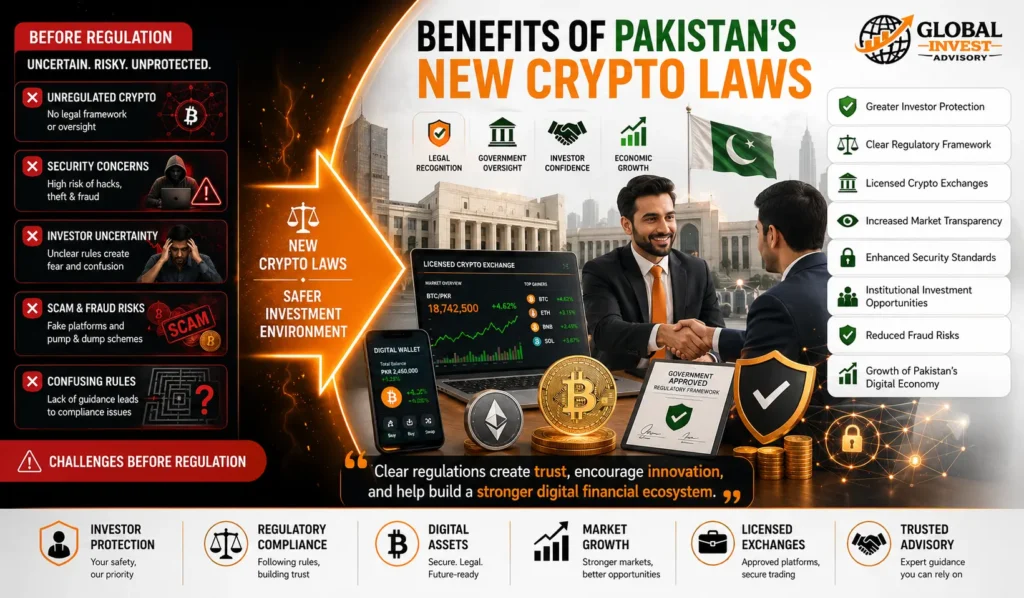
The updated framework provides several advantages:
- Greater investor confidence
- Better fraud prevention
- Improved regulatory clarity
- Enhanced international credibility
- Stronger AML compliance
- Encouragement for blockchain innovation.
Expert Tips Before Investing
Before investing in crypto:
- Verify whether the exchange is regulated.
- Complete KYC requirements.
- Never invest money you cannot afford to lose.
- Store digital assets securely.
- Diversify your investments.
- Stay updated with regulatory announcements from PVARA.
FAQs
Q1: Is crypto legal in Pakistan in 2026?
A: Yes. Cryptocurrency is regulated under the Virtual Assets Act, 2026, with oversight provided by PVARA. Licensed providers must comply with AML, KYC, and licensing requirements.
Q2: What is PVARA?
A: PVARA stands for the Pakistan Virtual Assets Regulatory Authority, the federal regulator responsible for licensing and supervising crypto businesses operating in Pakistan.
Q3: Can I legally trade Bitcoin in Pakistan?
A: Yes. Bitcoin trading is permitted under Pakistan’s regulated framework, provided users and service providers comply with applicable laws and use authorized platforms.
Q4: Are all crypto exchanges legal?
A: No. Exchanges must obtain approval under Pakistan’s licensing framework before legally offering regulated virtual asset services.
Conclusion
Pakistan has entered a new era of digital asset regulation. Rather than prohibiting cryptocurrency, the country has introduced a structured legal framework through the Virtual Assets Act, 2026 and the Pakistan Virtual Assets Regulatory Authority (PVARA). This shift offers greater legal clarity, stronger investor protection, and a pathway for responsible innovation in blockchain and virtual assets.
For investors, the key takeaway is simple: trade responsibly, use licensed platforms, stay compliant with evolving regulations, and follow official PVARA updates. As Pakistan’s crypto ecosystem continues to mature, informed decision-making will remain the foundation of safe and successful investing.