

The KSE-100 Index is the benchmark stock market index of the Pakistan Stock Exchange (PSX). It tracks the performance of 100 leading listed companies from different sectors, giving investors a snapshot of the overall direction and health of Pakistan’s stock market.
If you’ve recently started learning about investing, you’ve probably heard people talking about the KSE-100 Index on business news channels or financial websites. But what exactly is it, and why is it so important?
The good news is that understanding the KSE-100 index for beginners in Pakistan is much easier than it seems. In this guide, you’ll learn what the KSE-100 index is, how it works, how it is calculated, the difference between KSE-100 and PSX, and why every investor should monitor it before making investment decisions.
Whether you’re planning to invest in stocks or simply want to understand Pakistan’s financial markets, this beginner-friendly guide will give you a solid foundation.
What Is the KSE-100 Index?
The KSE-100 Index is Pakistan’s primary stock market benchmark. It tracks the performance of 100 major companies listed on the Pakistan Stock Exchange across various industries. Investors use it to understand market trends, evaluate economic sentiment, and compare the performance of their investment portfolios.
KSE-100 Index Meaning
The term KSE-100 stands for the Karachi Stock Exchange 100 Index. Although the Karachi Stock Exchange merged into the Pakistan Stock Exchange in 2016, the name “KSE-100” continues to be used because of its historical recognition.
The index represents the collective performance of selected companies rather than the entire stock market.
Why Was the KSE-100 Index Created?
The index was introduced to provide investors with a reliable benchmark for measuring market performance.
Without an index, investors would need to monitor hundreds of individual stocks, making it difficult to determine whether the market is generally rising or falling.
The KSE-100 simplifies this process by offering a single number that reflects the performance of Pakistan’s leading companies.
How the KSE-100 Index Works
The KSE-100 Index rises when the combined market value of its constituent companies increases and falls when their values decline.
However, not every company has the same influence.
Large companies with higher market capitalization generally have a greater impact on index movements than smaller companies.
For example:
- If a large banking company’s share price increases significantly, the index may rise noticeably.
- If a smaller company experiences a similar price increase, the overall impact on the index may be relatively small.
This weighted approach ensures that the index accurately reflects the performance of the market’s most influential companies.
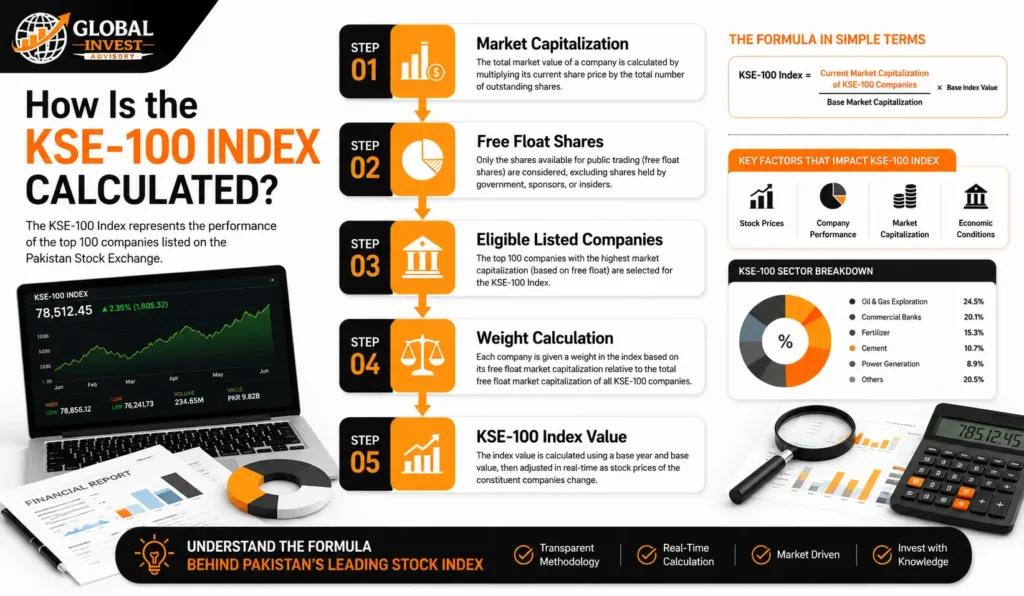
How Is the KSE-100 Index Calculated?
One of the most common beginner questions is “How is the KSE-100 index calculated?”
The index is calculated using a market capitalization-weighted methodology.
Simplified Explanation
The calculation considers:
- Company’s share price
- Number of outstanding shares
- Free-float market capitalization
- Weight of each company in the index.
Companies with a larger market value contribute more to the index than smaller companies.
Although the mathematical formula is complex, beginners only need to understand that larger companies have a greater effect on index performance.
KSE-100 vs PSX: What’s the Difference?
Many beginners confuse the KSE-100 Index with the Pakistan Stock Exchange.
They are related but not the same.
| KSE-100 Index | Pakistan Stock Exchange (PSX) |
| A market performance indicator | The stock exchange itself |
| Tracks 100 selected companies | Lists hundreds of companies |
| Used to measure market performance | Platform where stocks are traded |
| Not a company | Financial marketplace |
Simple Example
Think of the Pakistan Stock Exchange as a shopping mall.
The KSE-100 Index is like a report showing how the mall’s top 100 biggest stores are performing.
Why Investors Follow the KSE-100 Index
Professional investors monitor the index because it provides valuable information about overall market conditions.
It helps them:
- Measure market sentiment
- Identify bullish or bearish trends
- Compare portfolio performance
- Understand economic confidence
- Make informed investment decisions.
A rising index often indicates growing investor confidence, while a declining index may reflect economic uncertainty or market corrections.
Benefits of Understanding the KSE-100 Index
Learning about the KSE-100 helps investors make smarter decisions.
Key Benefits
- Understand overall market direction
- Avoid emotional investing
- Compare investment performance
- Identify sector trends
- Improve long-term investment planning
- Gain confidence before investing.
Even if you never trade frequently, understanding the index improves your financial knowledge.
KSE-100 Checklist for Beginners
Before making investment decisions, review this checklist.
Understand What the Index Represents
Know that the index reflects the combined performance of 100 selected companies rather than every listed stock.
Learn Basic Market Terms
Understand concepts such as:
- Market capitalization
- Dividends
- Earnings per share (EPS)
- Free float
- Bull market
- Bear market.
Don’t Judge the Entire Market by One Stock
A single company’s performance does not determine the direction of the KSE-100.
Always consider the broader market.
Follow Economic News
Monitor factors such as:
- Inflation
- Interest rates
- Exchange rates
- Corporate earnings
- Government policies
These can influence index movements.
Focus on Long-Term Trends
Daily market fluctuations are normal.
Long-term investors generally pay more attention to overall trends than short-term volatility.
Common Myths About the KSE-100
Myth 1: The Index Includes Every Company
False. It tracks only 100 selected companies.
Myth 2: A Rising Index Means Every Stock Is Increasing
Not necessarily. Some companies may decline even when the overall index rises.
Myth 3: The Index Guarantees Investment Returns
No. The index reflects market performance but does not guarantee profits.
Best Practices for Beginners
If you’re new to investing:
- Learn before investing.
- Diversify your portfolio.
- Avoid following market rumors.
- Review company fundamentals.
- Invest regularly.
- Monitor economic developments.
- Stay patient during market fluctuations.
Successful investing is based on research, discipline, and long-term planning.

Why Choose Global Invest Advisory?
Understanding the KSE-100 Index is just the first step. Making informed investment decisions requires continuous market research and expert guidance.
Global Invest Advisory helps investors through:
- Pakistan Stock Exchange research
- Market insights
- Portfolio analysis
- Investment advisory
- Educational resources
- Long-term investment planning.
Whether you’re a beginner or an experienced investor, professional guidance can help you navigate the stock market with greater confidence.
Conclusion
The KSE-100 Index is one of the most important tools for understanding Pakistan’s stock market. Instead of tracking individual companies, it provides a clear picture of how the country’s leading businesses are performing.
For beginners, learning what the KSE-100 index is, how it works, how it is calculated, and how it differs from the Pakistan Stock Exchange builds a strong foundation for making informed investment decisions. While the index should not be the only factor in choosing investments, it serves as a valuable benchmark for evaluating market conditions and long-term opportunities.
FAQs
Q1: What does the KSE-100 Index mean?
A: The KSE-100 Index is the benchmark stock market index of the Pakistan Stock Exchange. It tracks the performance of 100 leading listed companies and reflects the overall direction of the market.
Q2: Is the KSE-100 the same as the Pakistan Stock Exchange?
A: No. The Pakistan Stock Exchange (PSX) is the marketplace where shares are traded, while the KSE-100 Index is a benchmark that measures the performance of 100 selected companies listed on the exchange.
Q3: How many companies are included in the KSE-100 Index?
A: The KSE-100 Index consists of 100 companies selected from various sectors based on market capitalization and representation criteria, making it a broad indicator of Pakistan’s equity market.
Q4: Why is the KSE-100 important for beginners?
A: The index helps beginners understand overall market trends, compare investment performance, and make informed decisions without analyzing every listed company individually.
Q5: Can I invest directly in the KSE-100 Index?
A: Individual investors cannot purchase the index itself. Instead, they invest in the companies included in the index through a licensed brokerage account or invest in products that track the index if such options are available.